
 Comparison
7 Life Skills Class Features That Cut Recidivism
Last Updated: November 9, 2026
Quick Summary
A life skills class cuts recidivism when it targets the thinking underneath behavior instead of teaching content alone. The Readiness for Change Institute ties each module to a decision participants face within ninety days of release, then documents demonstrated work rather than attendance.
- Map every module to a near-term decision the participant will face within ninety days of release.
- Have participants answer the record question out loud at least three times in mock interviews.
- Build one documentation packet per participant so a probation officer gets proof in a single handover.
- Pair self-paced online modules with scheduled check-ins so nobody disappears into a login screen.
- Require a completed practice log before the final certificate is issued, not after.
Table of Contents
- Why a Life Skills Class Fails Without the Right Framework
- What a Cognitive Life Skills Class Actually Changes
- The Life Skills Curriculum Components That Predict Success
- How a Life Skills Class for Probation Satisfies Court-Ordered Requirements
- When a Life Skills Class Online Beats In-Person Delivery
- Measuring Success Metrics and ROI for Your Facility
- Accessibility for Neurodivergent Learners in Reentry Programs
- Post-Course Support Resources That Keep Skills in Use
- What to Ask Before Enrolling Someone in a Life Skills Class
- Frequently Asked Questions
Why a Life Skills Class Fails Without the Right Framework
Most life skills class programs fail for a predictable reason: they teach content without changing behavior. A workbook on budgeting does not stop someone from signing a bad lease. A lecture on interview etiquette does not calm the anxiety that makes a person freeze in the chair. The Readiness for Change Institute has spent years studying why some programs stick and others do not, and the pattern is consistent. Skills transfer only when the class targets the thinking underneath the behavior.
That distinction matters for facility managers under pressure to show results. Attendance logs are easy to produce. Changed behavior is harder to document and far more valuable.
A common mistake is buying a curriculum because it looks thorough. Page count is not the same as impact. The framework has to connect each module to a specific decision the participant will face after release, then give them a way to practice that decision before they face it for real. Without that link, you are paying for seat time.
If you want the broader evidence base on what actually reduces recidivism, our breakdown of proven strategies for preventing recidivism covers risk assessment through post-release support.
What a Cognitive Life Skills Class Actually Changes
A cognitive life skills class changes how participants read a situation before they act on it. The curriculum targets the automatic thought that says "this is unfair, so I will take what I need" and replaces it with a pause long enough to choose differently. That pause is the product.
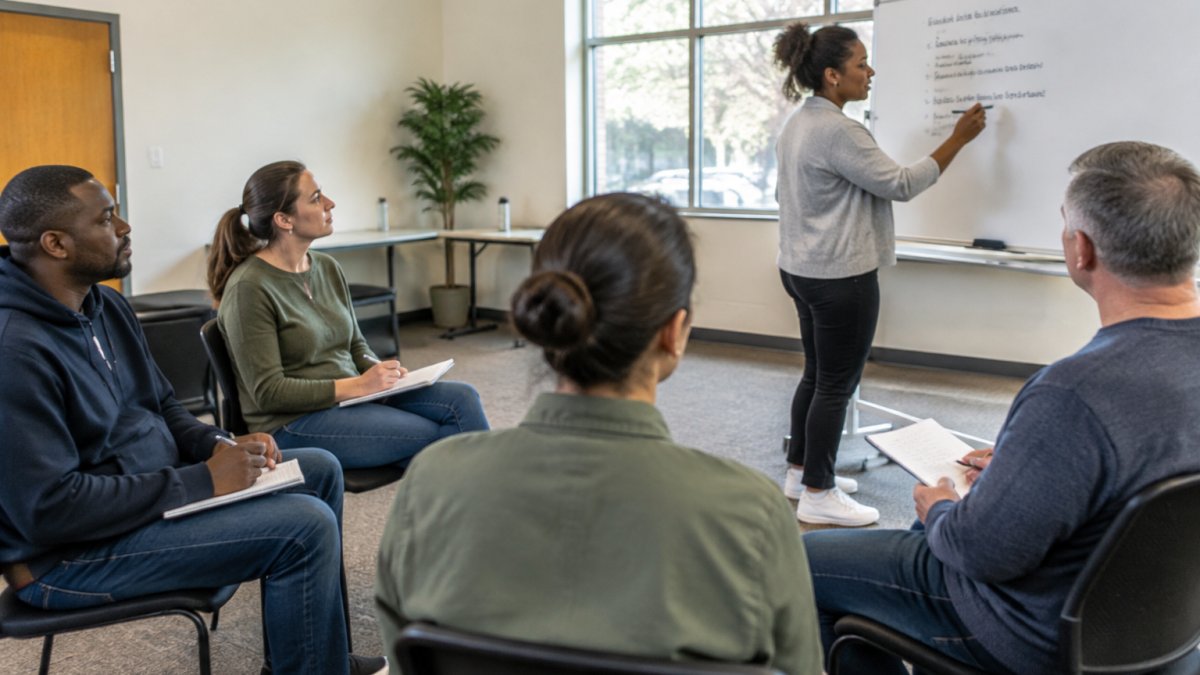
What most guides miss is that cognitive work has to be concrete. Asking someone to "reframe negative thinking" is useless. Asking them to walk through a specific moment, name the trigger, and rehearse two alternative responses builds a habit. Participants who practice this in class report catching themselves mid-reaction weeks later. That is the measurable shift.
Facility staff see the difference in incident reports and in how participants handle conflict on the unit. A cognitive approach gives officers shared language to reinforce what the class teaches.
The Life Skills Curriculum Components That Predict Success
The components that predict success are the ones tied to a decision the participant will make within ninety days of release. Anything abstract gets filed away and forgotten. A strong life skills curriculum maps each module to a near-term choice: where to live, how to explain a gap in work history, how to handle a confrontation without escalating.
Financial Literacy and Budgeting Modules
Financial literacy works when it starts with the participant's real numbers, not a textbook example. Trainees list actual income, actual obligations, and the gap between them. Budgeting becomes a survival tool rather than an exercise.
Cover these in order:
- Reading a pay stub and understanding deductions
- Building a bare-bones monthly budget from real figures
- Understanding lease agreements and what a signature commits them to
- Recognizing predatory lending and rent-to-own traps
- Opening and managing a basic bank account
Resume Building and Interviewing Skills
Resume building and interviewing skills need rehearsal, not handouts. Participants should leave with a finished document and having answered the hardest interview question out loud at least three times: "Tell me about your record."
The answer is not a confession. It is a short, honest statement followed by what changed. Practicing that sentence until it stops shaking is the entire point of the module.
| Module | Core Skill | Practice Format | What Success Looks Like |
|---|---|---|---|
| Financial literacy | Budgeting from real income | Worksheet with actual figures | Completed monthly budget |
| Lease agreements | Reading before signing | Annotated sample lease | Identifies three red flags |
| Resume building | Explaining work history | Draft and revise | Finished one-page resume |
| Interviewing | Answering the record question | Recorded mock interview | Delivers answer without freezing |
How a Life Skills Class for Probation Satisfies Court-Ordered Requirements
A life skills class for probation satisfies court-ordered requirements when it produces documentation a probation officer can verify and a judge can read. Completion alone is not enough. The file needs to show what was taught, what the participant demonstrated, and how progress was measured.
Documentation that holds up usually includes:
- Enrollment confirmation with dates
- Module completion records
- A certificate of completion naming the curriculum
- Any assessment or reflection work showing applied effort
Watch out: a certificate that lists only attendance invites a challenge. If the court sees a bare attendance record, it reads as seat time, not change. Build the file around demonstrated work.
Verifying a Certificate Against a Specific Court's Requirements
Most guides stop at "check with the court." That advice is useless to a facility manager who has to enroll twenty people by Friday. The practical work is a short verification sequence you can run before anyone signs up.
Start with the order itself. Court orders and probation conditions vary in how they describe the requirement. Some name a specific curriculum or provider. Some describe a category of class and leave the provider to the participant. Some specify a number of hours. Read the exact language on the order before assuming any online certificate will be accepted, because a certificate that satisfies one judge may be rejected by another in the same county.
Then confirm three things with the probation officer or court clerk in writing:
- Whether the provider must appear on an approved list the court maintains
- Whether the certificate must state hours, module titles, or a completion date in a particular format
- Whether the court requires a progress report before final completion, not just a certificate at the end
A common pattern is that courts accept self-paced online completion as long as the certificate names the curriculum, the hours, and the completion date, and the provider can supply a transcript or module record on request. The failure mode is a certificate that says only "completed life skills class" with no detail a clerk can match to the order.
Building a File That Survives Review
Keep the documentation in one packet per participant, in the order a reviewer will look for it: the court order or referral, the enrollment confirmation, the module completion record, the assessment or reflection work, and the certificate. When a probation officer asks for proof, you hand over one packet rather than hunting through three systems.
For participants and families navigating the court process, our guide on court-ordered classes online explains what to expect and how progress gets documented for probation.
When a Life Skills Class Online Beats In-Person Delivery
A life skills class online beats in-person delivery when scheduling, transportation, or facility access blocks attendance. Online removes the two most common reasons people miss sessions: no ride and no childcare. For a population managing court dates, work shifts, and unstable housing, that flexibility is not a convenience. It is the difference between finishing and dropping out.
Self-paced learning also lets participants move through material without disclosing their history to a room of strangers. Many people disengage in group settings because of shame. A private screen removes that barrier.
The trade-off is real. Online delivery loses the group accountability that keeps some people showing up. The best programs pair self-paced modules with scheduled check-ins so nobody disappears into a login screen.
Measuring Success Metrics and ROI for Your Facility
Success metrics for a reentry program should track behavior change, not attendance. Attendance tells you who showed up. It does not tell you whether anything changed. The metrics that matter connect the class to outcomes your facility already tracks.
Measure these:
- Completion rate versus enrollment
- Recidivism at six and twelve months post-release
- Employment or enrollment status at ninety days
- Housing stability at ninety days
- Incident reports on the unit during and after the class
- Participant self-assessments at start and finish
ROI comes from the same math your budget office already runs. Fewer returns mean fewer bed days, lower intake costs, and less strain on staff. Present the comparison in those terms and the case makes itself.
Our analysis of why measurable effort beats seat time walks through how to frame that comparison for decision-makers who control the budget.
Accessibility for Neurodivergent Learners in Reentry Programs
Accessibility for neurodivergent learners is the gap most reentry programs ignore. A meaningful share of incarcerated populations have learning differences, attention challenges, or trauma responses that make traditional instruction ineffective. When a class is built for one kind of learner, everyone else quietly fails.
Design for accessibility from the start:
- Short modules with clear stopping points
- Written and spoken instructions together
- Predictable structure so participants know what comes next
- No timed pressure on comprehension checks
- Multiple ways to demonstrate learning, not just written tests
These adjustments help every participant, not only those with a diagnosis. A class that respects attention limits and reading levels reaches more people. That is not accommodation. It is good instructional design.
Post-Course Support Resources That Keep Skills in Use
Post-course support resources keep skills in use after the certificate is filed. A class ends. The pressure of reentry does not. Without follow-up, participants default to old patterns within weeks, and the facility sees the return in incident reports and, eventually, in recidivism counts.
The problem with most follow-up is that it is passive. A phone number on a handout is not support. A check-in that nobody answers is not support. What works is structured practice with a record, so the participant has a reason to keep using the skill and the facility has evidence that the skill is being used.
Support that helps:
- Periodic check-in messages or calls with a specific prompt, not an open "how are you"
- A refresher module participants can return to when a decision comes up
- A simple way to document continued effort, such as a short daily log
- Referrals to local employment and housing resources
- A named contact for questions, so the participant is not routed to a general line
What Structured Practice Looks Like After the Certificate
A common pattern in programs that hold up is a defined practice window after completion, often around three weeks, in which the participant applies one skill per day and records what happened. The record is short: the situation, the skill used, and what the participant would do differently. That log does two things. It gives the participant a reason to notice their own decisions, and it gives the probation officer or case manager something concrete to review at the next check-in.
One model worth knowing is Palmetto Path, a program that helps participants practice change and document sustained effort over 21 days. The 21-day window is not magic. It is long enough to build a habit and short enough that participants finish it, which matters more than the exact number.
How a Facility Verifies Follow-Up Actually Happened
Follow-up is easy to claim and hard to prove. Build verification into the process from the start:
- Require a completed practice log before the final certificate is issued, not after
- Have the case manager review the log at the scheduled check-in and note it in the file
- Track whether participants who completed follow-up return at a different rate than those who did not
Watch out: if the follow-up is optional and unrecorded, you cannot tell a judge or a budget office whether it did anything. Treat the practice log as part of the completion file, not an extra.
Structured practice after the class is what turns a certificate into a habit, and a recorded habit is what turns a program into evidence.
What to Ask Before Enrolling Someone in a Life Skills Class
Before enrolling anyone, ask the questions that separate a real program from a certificate mill. The answers tell you whether the class will change behavior or just fill a file.
Ask these:
- What does the curriculum actually cover, module by module?
- How is progress measured beyond attendance?
- What documentation will the participant receive?
- Is delivery self-paced, live, or blended?
- How does the program handle learning differences?
- What support exists after completion?
- How does the provider measure whether skills stick?
If a provider cannot answer the last two, keep looking. Completion without follow-up is a receipt, not a result. When you have specific questions about fit, timing, or next steps, contact RCI and share the context so you get a useful answer rather than a sales pitch.
Facility managers carry a hard mandate: reduce returns while working inside real budget limits. The Readiness for Change Institute builds evidence-based programs around a proprietary change model developed from decades of research, with structured support that helps participants assess where they stand, build essential skills, and take action. Our programs are built for real-world application, not theory, and they give your staff documentation that shows effort, not just attendance. Get started with The Readiness for Change Institute and give your reentry program a framework that produces measurable change.
Frequently Asked Questions
What is taught in a life skills class for justice-involved adults?
A well-built life skills class covers budgeting and personal finance, resume building and interviewing skills, lease agreements and apartment applications, behavioral pattern analysis, and independent living tasks. The strongest programs also address root causes such as impulse control and growth mindset, and they end with a certificate of completion that probation officers and courts can verify. Ask for the module list in writing before you enroll anyone.
How can a life skills class support reentry after release?
Reentry succeeds when people can handle the practical tasks waiting for them on day one: a lease, a budget, a job interview, and a plan for the moments that used to lead to trouble. A life skills class that teaches these tasks with interactive practice, not lectures, gives participants a repeatable process. Pair it with post-course support so skills stay in use during the first stressful months.
How do online and in-person life skills classes differ?
A life skills class online removes scheduling and transportation barriers, which matters for people on probation who work or lack reliable transit. In-person sessions build group accountability and are easier for facilities to supervise. The curriculum should be the same either way. Ask whether the online version is self-paced, whether it tracks completion, and whether the certificate of completion carries the same weight with courts.
What should jail managers look for in a life skills program?
Look for a defined curriculum with measurable modules, evidence behind the model, accessibility for neurodivergent learners, and documentation a probation officer can act on. Ask how the provider measures success metrics and ROI, and whether post-course support exists. Pricing depends on group size and delivery format, so request a quote rather than assuming a per-participant figure.