 comparison
Hudson Coaching Alternative for Students: 5 Top Picks
Table of Contents
- Why Students Seek a Hudson Coaching Alternative
- How We Evaluated These Student Coaching Programs
- 1. The Readiness for Change Institute: Best for Justice-Involved and College-Bound Students
- 2. BetterUp: Best for On-Demand Digital Coaching Access
- 3. SUCCESS Coaching Certification: Best for Budget-Conscious Students
- 4. Center for Executive Coaching: Best for Leadership-Focused Students
- 5. Coach Training EDU: Best for All-Inclusive ICF-Accredited Training
- Evidence-Based Student Coaching Programs: What the Research Shows
- Coaching Program Duration and Structure: What to Expect
- Tools for Measuring Student Coaching Success
- Prerequisites, Costs, and Time-to-Completion: What Competitors Miss
- Step 1: Verify Prerequisites Before You Do Anything Else
- Step 2: Pin Down the True Cost, Not the Advertised Cost
- Step 3: Confirm the Completion Window and What Happens If You Miss It
- Step 4: Sequence the Three Variables Against Your Calendar
- The Consequence of Skipping This Sequence
- For Students Weighing a Hudson Coaching Alternative
- Which Hudson Coaching Alternative Fits Your Situation?
- Frequently Asked Questions
Last Updated: September 20, 2026
Why Students Seek a Hudson Coaching Alternative
Students searching for a Hudson coaching alternative usually arrive at the same wall: the programs built for corporate executives were never designed for someone navigating probation, a first semester, or a GED-to-college jump. The Readiness for Change Institute works with exactly these students, and we see the mismatch up close. Most legacy coaching institutes assume you already have a job title, a budget, and a calendar you control.
You may not have any of those things yet.
The result is a market full of options that technically qualify as coach training but practically ignore the student's reality. Cost sits in the thousands. Scheduling assumes weekday availability. Curriculum leans on organizational dynamics that mean nothing to a 19-year-old trying to pass statistics. A hudson coaching alternative for students has to solve different problems: affordability, flexibility, and proof of progress that a probation officer or a financial aid office will actually accept.
That gap is what this guide addresses. Below, we compare programs on the criteria students actually care about, and we flag the prerequisite rules, completion timelines, and hidden costs most comparison pages skip.
How We Evaluated These Student Coaching Programs
Programs were scored on five criteria, weighted for students rather than working professionals. Cost transparency came first, because a program you cannot afford is not a program. Time-to-completion came second: students on probation timelines or semester calendars cannot wait 18 months for a credential.
The remaining three criteria were accreditation and credentialing standards, format flexibility for students juggling work or court obligations, and whether the curriculum produces something concrete a student can show a third party. We weighted "concrete output" heavily because a certificate that does not move a probation officer, admissions committee, or employer is decoration.
| Criterion | What We Checked | Why It Matters for Students |
|---|---|---|
| Cost transparency | Published pricing vs. "contact us" | Budget planning without surprises |
| Time-to-completion | Stated program length | Semester and probation timelines |
| Accreditation | ICF alignment, credentialing path | Whether the certificate travels |
| Format flexibility | Live vs. self-paced, virtual options | Work, court, and class schedules |
| Concrete output | Portfolio, assessments, documented progress | Evidence for courts and schools |
We also applied a rule most review sites ignore: if a program cannot tell you its price before you apply, that is a finding, not a footnote.
1. The Readiness for Change Institute: Best for Justice-Involved and College-Bound Students
The Readiness for Change Institute is the strongest fit for students navigating the justice system or preparing for college, because its programs were built for those transitions rather than adapted from corporate coaching. The proprietary model is grounded in founder Dr. Dukes' 35+ years of research experience, and the curriculum centers on assessing where you stand, building specific skills, and taking documented action steps.
What separates this program from general coaching certifications is the audience. Most coach training exists to produce coaches. This program exists to produce change in the participant's own life, which is a different objective entirely.
Program Structure and What Participants Actually Do
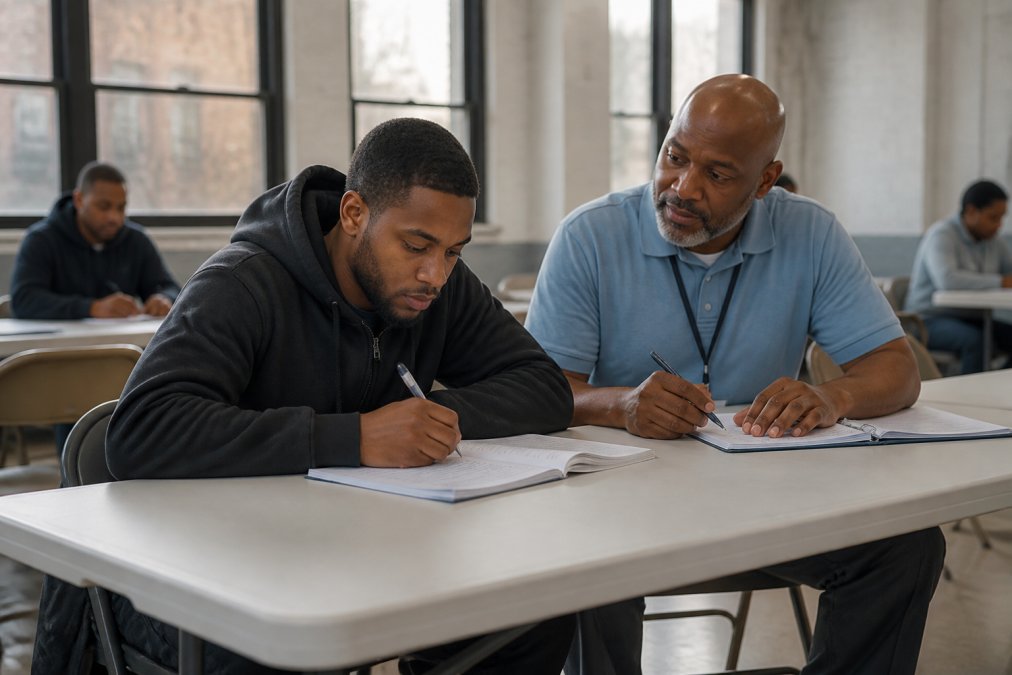
Participants move through a structured sequence: assess current standing, identify the specific skills their transition demands, and build a plan with measurable steps. The work is practical. You are not memorizing coaching theory for its own sake; you are producing evidence of progress you can point to.
That matters enormously if you are on probation. A probation officer who has watched people collect certificates for years wants documentation of behavioral change, not another PDF. Structured assessments and action logs give you something concrete to put in front of a court.
For college-bound students, the same structure addresses the imposter syndrome problem directly. Readiness is not a feeling you wait for. It is a set of skills you build, and the program treats it that way.
Pricing depends on the specific program track and delivery format, so check the current program pages for details rather than relying on secondhand numbers.
2. BetterUp: Best for On-Demand Digital Coaching Access
BetterUp is a large-scale digital coaching platform that connects individuals with vetted professional coaches, and it earns its place here on infrastructure. The platform matches participants to coaches through an AI-driven process and provides mobile and web scheduling that fits around a class schedule.
The vetting standard is the selling point: coaches are drawn from a small fraction of applicants, which generally means quality control. Progress tracking through evidence-based assessments is genuinely useful if you want data on your own development.
Here is the limitation. BetterUp is primarily enterprise-focused, which means individual students often cannot buy access directly. If your college or an employer sponsors it, the calculus changes completely. If you are paying out of pocket as an individual, you may find the door closed.
Best for students whose school or workforce program already provides access.
3. SUCCESS Coaching Certification: Best for Budget-Conscious Students
SUCCESS Coaching Certification publishes a flat one-time price of $2,497, and that transparency alone puts it ahead of programs that hide pricing behind a consultation. The curriculum is ICF-aligned and delivered fully online, with training materials included in the base cost.
For a student who wants a structured path into coaching without institutional overhead, this is a reasonable entry point. The brand recognition in personal development circles does some work for you when you start looking for clients.
The honest drawback: it lacks the deep organizational coaching focus that executive-track programs carry. If your goal is leadership coaching inside a company, this will feel thin. If your goal is practical coaching skills at a predictable price, it holds up.
Best for students who need a known total cost before committing.
4. Center for Executive Coaching: Best for Leadership-Focused Students
Leadership and organizational dynamics define this program. The curriculum targets executive coaching methodologies, and the ICF-accredited training hours count toward credential requirements. Mentorship and business development support round out the offering, which matters if you intend to build a practice rather than just hold a certificate.
The specialization is both the strength and the constraint.
Best for students with a clear corporate leadership coaching goal.
5. Coach Training EDU: Best for All-Inclusive ICF-Accredited Training
Coach Training EDU bundles instruction, mentor coaching, and business development into a single tuition figure, which removes the hidden-cost problem that plagues this category. The program holds ICF Level 2 accreditation and includes live instruction components.
Evidence-Based Student Coaching Programs: What the Research Shows
Evidence-based student coaching programs share a common structure: they measure a baseline, target specific skills, and document change over time. That pattern shows up across reentry, academic readiness, and workforce development work, and it is the opposite of motivational programming that leaves no record behind.
Coaching Program Duration and Structure: What to Expect
Coaching program duration is the single most under-benchmarked variable in this category, and for students it is often the deciding one. A program can be excellent and still be the wrong choice if its completion window collides with a semester start, a financial aid disbursement date, or a scheduled review hearing. This section gives you a practical way to benchmark duration against your actual calendar instead of a vague sense of "how long it takes."
The Three Duration Buckets You Will Encounter
Most student-accessible coaching programs fall into one of three structural buckets. Knowing which bucket a program sits in tells you more than its marketing page will.
- Self-paced, open-window (roughly 3-6 months of part-time effort). You control the pace. The risk is drift: without external deadlines, many students stall past the point where the credential would have helped them. Best for students with irregular schedules and strong self-discipline.
- Cohort-based, fixed start (roughly 6-12 months). You join a group and move through together. Accountability is high, but you cannot start mid-cycle, and missing a cohort can push your start date out by weeks or months. Best for students who need structure and can commit to a start date.
- Live-instruction, extended (roughly 12-18 months). Weekly or biweekly live sessions over a long horizon. This is the format most likely to collide with shift work, court dates, or a heavy course load. Best for students with predictable weekly availability.
How to Benchmark a Program Against Your Own Timeline
Do this before you pay anything. Write your hard deadlines on paper in chronological order, then read each program's stated length against that list.
- List your fixed dates. Semester start and drop/add deadlines, financial aid filing and disbursement windows, probation or parole review dates, work shift rotations, and any court appearances already scheduled.
- Convert the program length into a finish date. If a program says "6 months" and you would start in October, your finish lands in April, check what that collides with.
- Check the start cadence. Ask when the next cohort begins and how often cohorts launch. A program that only starts twice a year can add up to six months of waiting before your first session.
- Ask what happens if you fall behind. Some programs grant extensions; others enforce a hard deadline and require you to re-enroll and re-pay. Get this in writing before you commit.
- Confirm the completion window in writing. "Self-paced" often means "self-paced within a 12-month access window." The access window, not the average completion time, is what actually constrains you.
Where to Look for the Real Numbers
Marketing pages rarely state duration precisely. The reliable places to find it are the enrollment agreement or student handbook, the refund policy (which usually defines the enrollment period), and the accreditation or credentialing body's published requirements if the program leads to a credential. If a program leads to an ICF credential, the credentialing body publishes its own education and mentor-coaching hour requirements, and those hours set a floor on how short the program can legitimately be.
The Consequence Most Students Miss
A duration mismatch is not just inconvenient. If you enroll in a program that finishes after your financial aid disbursement window closes, you may lose access to funds you were counting on. If it finishes after a review hearing, you may have nothing new to show at that hearing. If it overlaps a semester's heaviest weeks, your grades can suffer while you chase a credential.
A Note on "Average Completion Time"
When a program quotes an average completion time, ask whether that average includes students who dropped out. Averages that exclude non-completers are systematically optimistic. Ask for the median time to completion among students who finished, and ask what percentage of enrollees finish within the stated window. If the program cannot answer, treat the quoted duration as a best case, not a plan.
Tools for Measuring Student Coaching Success
Tools for measuring student coaching success fall into three categories, and a program worth your money should offer at least two of them. Self-assessment instruments establish a baseline. Behavioral tracking captures what you actually did between sessions. Third-party verification, such as mentor observation or documented hours, produces evidence someone else will accept.
Prerequisites, Costs, and Time-to-Completion: What Competitors Miss
Prerequisites, cost, and timeline are crucial considerations. For a student, they are one package, and the package has to be verified in a specific order. This section walks through that order step by step, with the timing and the places to look.
Step 1: Verify Prerequisites Before You Do Anything Else
Prerequisite requirements are the most underreported detail in this category. Some programs require a bachelor's degree or prior coaching experience; others require nothing beyond payment and a valid ID. Discovering a prerequisite after you have committed wastes a semester you cannot get back.
Where to look, in order:
- The admissions or enrollment requirements page, not the marketing homepage. Look for the words "eligibility," "admission requirements," or "who this is for."
- The enrollment agreement or terms of service. Prerequisites are sometimes buried here rather than on the admissions page.
- The credentialing body's published requirements, if the program leads to a credential. A credentialing body's education requirements can function as a de facto prerequisite even when the program itself states none.
- A direct question to admissions in writing. Ask: "What are the minimum qualifications to enroll, and is any prior degree or experience required?" Keep the reply.
Step 2: Pin Down the True Cost, Not the Advertised Cost
Advertised tuition is rarely the full cost. The gap between the two is where student budgets break. Ask about each of the following and get the answer in writing:
- Base tuition and whether it is a flat rate or varies by track or format.
- Mentor coaching hours, if the program leads to a credential. These are often billed separately and can add a meaningful amount.
- Materials, assessments, or platform fees not included in base tuition.
- Credential application fees paid to the credentialing body, which are separate from program tuition.
- Re-enrollment or extension fees if you fall behind or need more time.
- Refund policy and withdrawal window, including the exact date after which no refund is available.
Step 3: Confirm the Completion Window and What Happens If You Miss It
Time-to-completion has two numbers that matter: the typical time and the maximum allowed time. Ask for both. Then ask three follow-up questions:
- How many total instructional hours are required, and how many of those are live versus self-paced?
- What is the maximum access window, and what happens when it expires?
- If I fall behind, is there an extension, and does it cost anything?
Step 4: Sequence the Three Variables Against Your Calendar
Once you have prerequisites, true cost, and completion window for each candidate program, lay them against your fixed dates in this order:
- Prerequisites first. Eliminate any program you cannot qualify for, regardless of cost or speed.
- Cost second. Eliminate any program whose true cost exceeds your budget, including add-ons.
- Timeline third. Eliminate any program whose completion window does not fit before your next hard deadline.
The Consequence of Skipping This Sequence
A cheap program with a prerequisite you cannot meet is expensive, because you lose the time and any non-refundable fees. A fast program with live sessions you cannot attend is slow, because you fall behind and pay for an extension. A prestigious program with an unknown total cost is a budget risk you cannot plan around. The sequence above is designed to surface all three problems before you pay, not after.
For Students Weighing a Hudson Coaching Alternative
The practical takeaway is to treat prerequisites, cost, and timeline as a single verified package, in that order. Verify each one in writing, against your own calendar, before you commit a dollar or a semester. A program that survives all three checks is worth your time. A program that fails any one of them is not, no matter how strong its reputation.
Which Hudson Coaching Alternative Fits Your Situation?
The right choice depends on your transition, not on rankings. A student leaving incarceration needs documented behavioral evidence and a format that survives an unpredictable schedule. A high school senior preparing for college needs readiness skills and a structure that builds confidence before the first semester starts. A parent supporting a college-bound child needs to understand what their student is facing.
Match your situation to the list:
- Justice-involved or college-bound: The Readiness for Change Institute, because the program targets the transition itself and produces documentation you can show.
Frequently Asked Questions
What is a Hudson certified coach, and why would a student want an alternative?
A Hudson certified coach completes training through the Hudson Institute of Coaching, which emphasizes developmental and transitional coaching. Students often seek a Hudson coaching alternative because their programs are built primarily for working professionals and executives, not for students navigating college transitions or reentry after incarceration. Alternatives focused on student needs typically address academic readiness, life skills, and measurable behavior change rather than corporate leadership development.
How do evidence-based student coaching programs differ from motivational coaching?
Evidence-based student coaching programs use structured assessments, defined competencies, and measurable outcomes rather than relying on inspiration alone. They track progress through validated tools and adjust the coaching approach based on data. This matters for students who need concrete proof of growth, such as documentation for a probation officer or a college readiness portfolio. The Readiness for Change Institute builds its model on decades of research into behavior change rather than generic encouragement.
What should students look for in coaching program duration and structure?
Look for a published timeline, session frequency, and a clear completion benchmark. Programs range from a few weeks of intensive work to year-long certifications. Ask whether sessions are live or self-paced, whether mentor coaching is included, and what you must complete before finishing. A program with vague duration claims often lacks the structure students need to stay accountable, especially when balancing coursework, work, or court obligations.
What tools for measuring student coaching success should a program provide?
Strong programs offer pre- and post-assessments, goal-tracking dashboards, session notes, and competency rubrics. Some use third-party validated instruments. The Readiness for Change Institute provides structured documentation participants can share with courts, schools, or employers. Before enrolling, ask what evidence you will receive at completion and whether it is recognized by the institutions you need to satisfy.
Are there coaching models specifically designed for academic and life transitions?
Yes. Some programs focus on transition coaching, which addresses the specific challenges of moving from high school to college, from incarceration to community life, or from dependent to independent learning. These models combine skill-building with accountability structures. The Readiness for Change Institute tailors its proprietary model for both higher education transitions and justice system reentry, which is a narrower focus than general life coaching certifications offer.